Ad
Skip to content
Read full article about: Microsoft and Stripe bring shopping checkout directly into Copilot chat for US users

In a glorious AI future, you'll order pizza directly from Excel. Microsoft and Stripe are teaming up to bring shopping to the AI assistant Copilot. US users will soon be able to buy products directly in the chat without ever leaving the app. At launch, the feature includes Etsy retailers and brands like Urban Outfitters and Anthropologie.

Called "Copilot Checkout," the feature runs on Stripe and uses the "Agentic Commerce Protocol," an open standard for AI-powered commerce that Stripe helped develop. ChatGPT already uses the same protocol with Stripe Checkout.

Meanwhile, Google is developing its own open protocol called "Agent Payments Protocol" (AP2), backed by more than 60 companies, including Mastercard, PayPal, Coinbase, and Adobe. Both OpenAI and Google have also announced partnerships with PayPal to enable payments directly in AI chats.

There's real money at stake here. If purchases happen through chatbots, the providers can take a cut of every transaction. OpenAI recently launched its own product research agent to position chatbots as a shopping channel. Copilot in Edge already offers AI-powered shopping tools in the US.

Read full article about: EU orders X to preserve all Grok-related documents through 2026

The European Commission has ordered Elon Musk's platform X to preserve all internal documents and data related to the AI chatbot Grok through the end of 2026. A Commission spokesperson confirmed the order to Reuters on Thursday. The directive expands on a preservation requirement sent to X last year that focused on algorithms and the spread of illegal content.

The order stems from the Commission's concerns about regulatory compliance. However, the measure does not mean a new formal investigation under the Digital Services Act (DSA) has been opened.

Earlier this week, the Commission condemned images generated by Grok and spread on X showing unclothed women and children as illegal.

Read full article about: Arm Holdings establishes new business unit for robotics and automotive

Arm Holdings has restructured its business and created a unit called "Physical AI" to enter the robotics market. The British company, which licenses chip technology for smartphones and other devices, will operate three main business units in future: Cloud and AI, Edge (mobile devices and PCs) and Physical AI, which combines automotive and robotics.

Drew Henry will head the new unit. Arm plans to increase staff for robotics. According to marketing chief Ami Badani, the merger of automotive and robotics is due to similar customer requirements in terms of power consumption, safety and reliability. Robotics dominated CES 2026 with dozens of exhibitors of humanoid robots.

Read full article about: Claude creator Anthropic reportedly hits $350 billion valuation as it raises another $10 billion

Anthropic, the company behind the Claude chatbot, is raising $10 billion at a valuation of $350 billion - nearly double its $183 billion valuation from just four months ago. Singapore's sovereign wealth fund GIC and Coatue Management are leading the round, which is expected to close in the coming weeks. The final numbers could still shift, according to the Wall Street Journal.

This new capital comes on top of the up to $15 billion that Nvidia and Microsoft plan to invest in the company. As part of that arrangement, Anthropic will purchase $30 billion worth of computing capacity from Microsoft Azure running Nvidia systems. The company expects to break even for the first time in 2028.

Anthropic's raise follows xAI's recent announcement of a $20 billion funding round at a valuation exceeding $230 billion. OpenAI is also reportedly planning its next round of up to $100 billion at a $750 billion valuation. Based on these numbers, the AI investment boom isn't cooling off anytime soon in 2026.

Read full article about: Google's "Nano Banana" owes its odd name to a project manager working alone at 2:30 a.m.

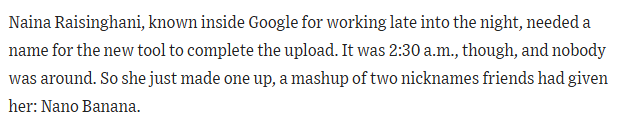
Google's "Nano Banana" is currently the most powerful image model on the market, but the name is undeniably strange. According to the Wall Street Journal, the moniker was a 2:30 a.m. accident. When project manager Naina Raisinghani needed a name to upload the model to the benchmark platform LM Arena, no one was around to consult. She simply mashed up two of her own nicknames: Nano and Banana. Within days, the tool shot to the top of the performance rankings and became a social media trend. Compared to this late-night improvisation, the name "Gemini" has a slightly more deliberate origin story.

via WSJ

Another interesting detail from the WSJ report: An OpenAI researcher, of all people, apparently helped push Google co-founder Sergey Brin out of retirement and back into the company's AI efforts. Daniel Selsam asked him at a party why he wasn't working full-time on AI given the rise of ChatGPT. That question helped drive Brin back to Google to accelerate the company's AI ambitions.

Read full article about: New Artificial Analysis benchmark shows OpenAI, Anthropic, and Google locked in a three-way tie at the top

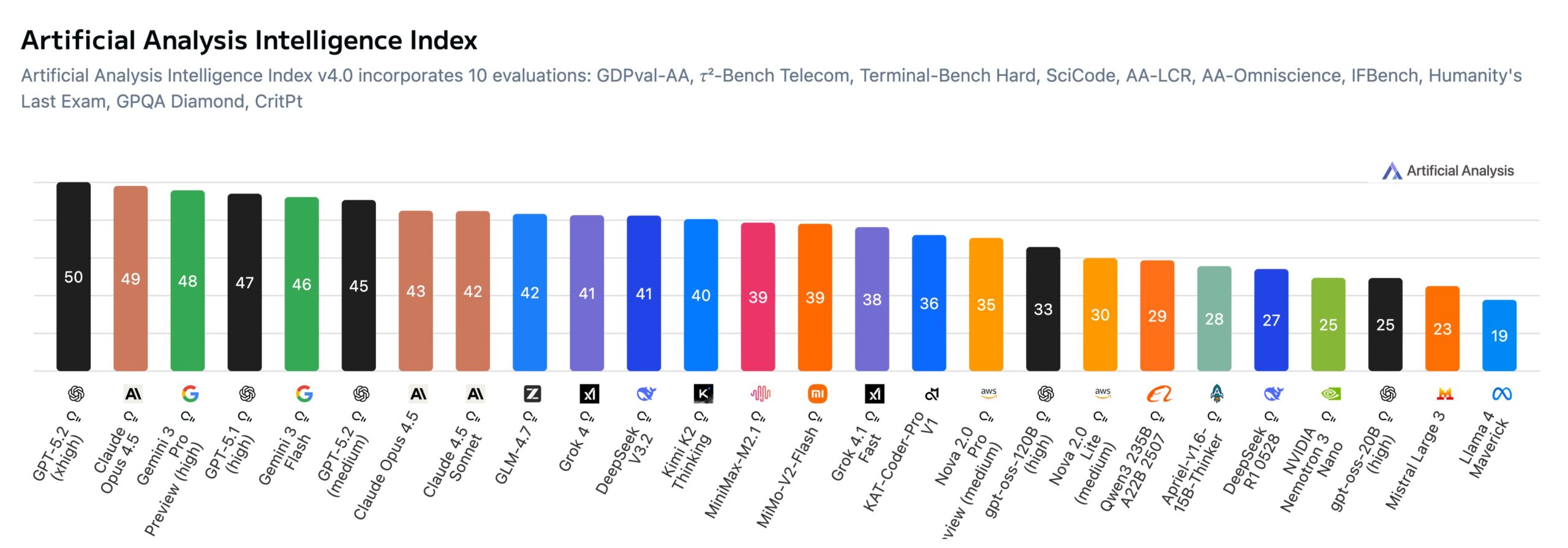
Artificial Analysis just released version 4.0 of its Intelligence Index, ranking AI models across multiple benchmarks. OpenAI's GPT-5.2 at its highest reasoning setting takes the top spot, with Anthropic's Claude Opus 4.5 and Google's Gemini 3 Pro close behind.

The index scores models across four equally weighted categories: Agents, Programming, Scientific Reasoning, and General. Results are less saturated this time, with top models peaking at 50 points compared to 73 in the previous version.

Artificial Analysis Intelligence Index v4.0: GPT-5.2 (xhigh) leads with 50 points, followed by Claude Opus 4.5 (49) and Gemini 3 Pro Preview (48). It's a tight race at the top. | Image: Artificial Analysis
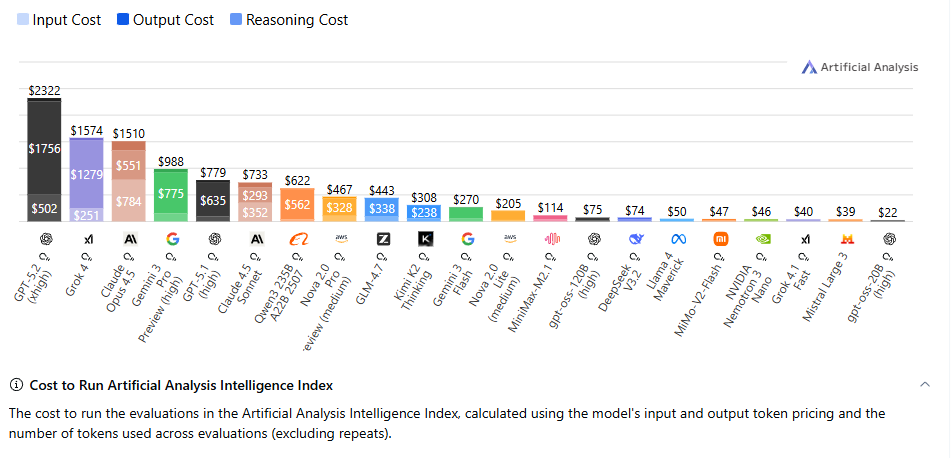
At the top of the cost table is GPT-5.2 (xhigh) with a total cost of $2,322, followed by Grok 4 ($1,574) and Claude 4.5 Opus ($1,510). Gemini 3 Pro Preview trails significantly behind at $988. | Image: Artificial Analysis

The updated index swaps three older tests (AIME 2025, LiveCodeBench, and MMLU-Pro) for a fresh set: AA-Omniscience checks model knowledge across 40 topics while flagging hallucinations, GDPval-AA tests models on practical tasks across 44 professions, and CritPt tackles physics research problems. Artificial Analysis says it ran all tests independently using a standardized approach, with full details available on its website.

Read full article about: China investigates Meta's Manus acquisition for export control violations

China's Ministry of Commerce is looking into whether Meta's purchase of AI startup Manus, valued at $2 billion or more, violated export control rules. According to the Financial Times, authorities want to know if the relocation of Manus employees and technology to Singapore, followed by the sale to Meta, should have required an export license.

The company's core team relocated to Singapore in the summer of 2025 to distance itself from China-related geopolitical risks. The Beijing offices have sat empty ever since. All three founders, Red Xiao, Peak Ji, and Tao Zhang, also moved from China to Singapore.

The relocation came after a $75 million funding round led by US firm Benchmark. That investment triggered its own set of questions, but from the opposite direction. The US Treasury Department investigated whether American money was flowing into a Chinese AI company without proper authorization. Meta says there were no longer any Chinese ownership stakes in Manus by the time the deal closed. The founders had previously turned down investment offers from local Chinese government entities.

Read full article about: AI industry finds its 2026 narrative as OpenAI and Microsoft argue users are the bottleneck, not models

The AI industry seems to have found its narrative for 2026: AI models are more capable than the people using them. Following Satya Nadella, OpenAI product head Fidji Simo has now weighed in. Her message: "AI models are capable of far more than how most people experience them day to day." OpenAI's goal for 2026 is closing the gap between what AI can do and how people actually use it. The company that turns research into useful products will lead the market.

ChatGPT has over 800 million weekly active users and one million business customers, according to Simo. In 2026, OpenAI plans to evolve it from a chatbot to a more personal "super assistant," one that understands goals, stores context, and helps proactively. A leaked mid-2025 document describes how such a super assistant would compete for human attention.

For businesses, OpenAI wants to build an automated workflow platform, with Codex serving as an "automated teammate" for developers. To justify higher prices, OpenAI needs major AI agent improvements: the company is reportedly considering plans costing up to 20,000 dollars per month.

Read full article about: OpenAI loses top AI researcher Jerry Tworek after seven years

OpenAI is losing yet another senior researcher: Jerry Tworek is out after nearly seven years at the company. Tworek shared the news in a message to his team. He was a key player in building GPT-4, ChatGPT, and OpenAI's first AI coding models, while also helping push new scaling boundaries. Most recently, he ran the "Reasoning Models" team, working on AI systems that can handle complex logical reasoning. He was part of the core group behind the o1 and o3 models, the foundation for much of OpenAI's recent AI progress.

Tworek says he wants "to try and explore types of research that are hard to do at OpenAI." That sounds like a not-so-subtle dig at CEO Sam Altman's relentless focus on products and revenue, which has reportedly been causing tension among researchers. No word yet on where Tworek is headed next.

Read full article about: Abu Dhabi's TII claims its Falcon H1R 7B reasoning model matches rivals seven times its size

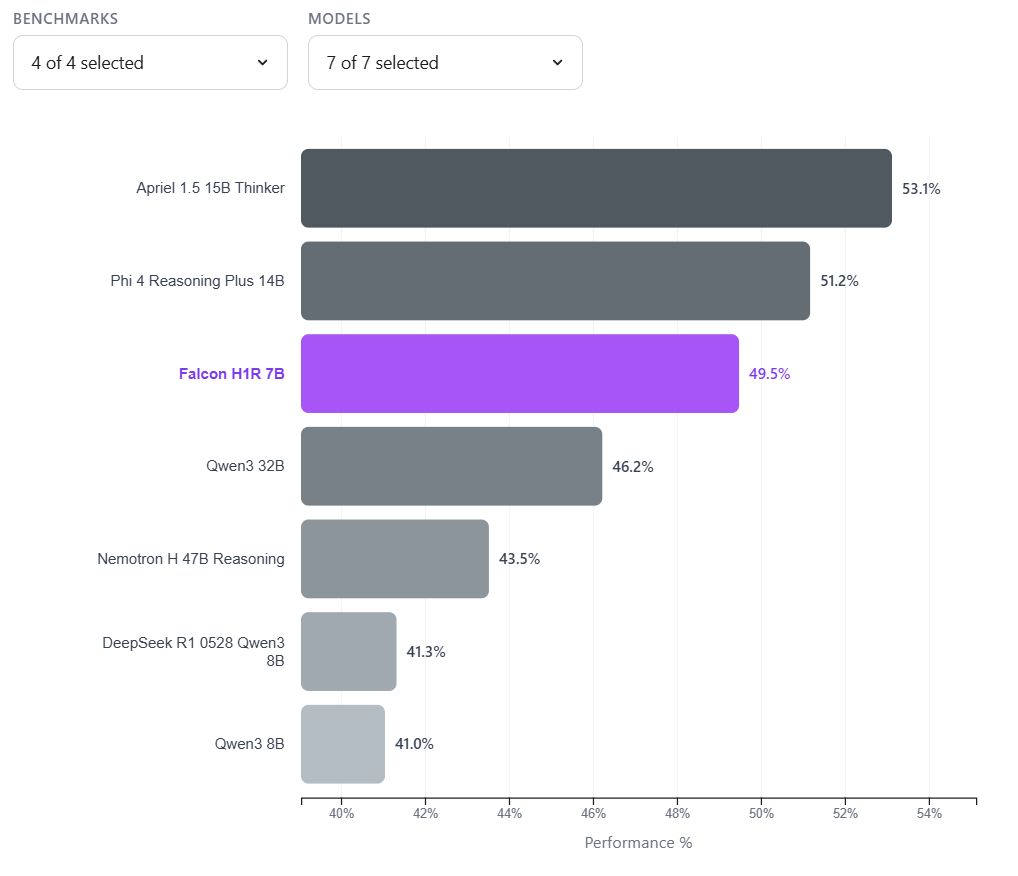
The Technology Innovation Institute (TII) from Abu Dhabi has released Falcon H1R 7B, a compact reasoning language model with 7 billion parameters. TII says the model matches the performance of competitors two to seven times larger across various benchmarks, though as always, benchmark scores only loosely correlate with real-world performance, especially for smaller models. Falcon H1R 7B uses a hybrid Transformer-Mamba architecture, which lets it process data faster than comparable models.

Falcon H1R 7B scores 49.5 percent across four benchmarks, outperforming larger models like Qwen3 32B (46.2 percent) and Nemotron H 47B Reasoning (43.5 percent). | Image: Technology Innovation Institute (TII)

The model is available as a complete checkpoint and quantized version on Hugging Face, along with a demo. TII released it under the Falcon LLM license, which allows free use, reproduction, modification, distribution, and commercial use. Users must follow the Acceptable Use Policy, which TII can update at any time.